EIGRP Named Mode
Description
In this guide, we will cover configuring a simple EIGRP topology using "named" mode.

Configuration
First, let's see from show commands and our network diagram what networks we need to advertise to our neighbor
Now let's configure EIGRP named mode.
CLI Configuration
The full configuration is pictured below.


Verification
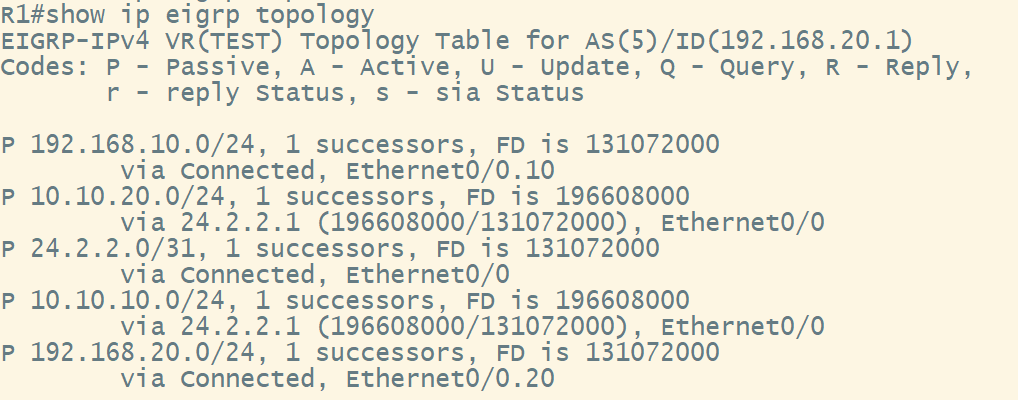
To verify that your EIGRP topology is fully converged, we have a LOT of show commands. I will cover the ones I have used the most in day-to-day troubleshooting on an EIGRP domain.


Wireshark
Now let's look at a packet capture of the EIGRP process. We will take a dive into a hello packet and an update packet.
1. This image shows us the entire process, from EIGRP hellos to EIGRP updates and EIGRP acknowledgments.

2. In This image, we will look inside the EIGRP Hello Packet. Inside the EIGRP hello header, we can see the opcode (5), which means this is Hello packets, Parameters (K Values which have to match), and the Autonomous System Number, which also has to match on both sides.

3. In this image, we will look inside an EIGRP Update Packet. In this packet, we see R1 is sending the known networks to R2. R2 will take this update, place these networks into the topology table, run the DUAL algorithm, and place these networks into the global routing table.

Conclusion
As we can see in the configurations above, configuring EIGRP and getting our routers to dynamically share routes is relatively simple and easy. Now when we get to larger scale networks and tuning our EIGRP, that's a different story. In the upcoming guides, we will go over additional EIGRP configurations like summarization, passive interface, authentication, stub routing, default-information originate, leak-maps, distribute-lists, load-balancing, and offset lists.
Last updated